
Updated 2026-09-28 · Update 29.5
Blox Fruits Value List — Every Fruit Value
Current trading values for every tradable fruit: physical, permanent, demand and trend — refreshed weekly from live trading activity. Click a column to sort, or open a fruit for the full breakdown. Testing an offer? Run it through the trade calculator before you accept.
| Fruit | Rarity | Physical | Permanent | Demand | Trend |
|---|---|---|---|---|---|
 Dragonoverpay Dragonoverpay | Mythical | 850M | 2.9B | 10/10 | → |
 Kitsuneoverpay Kitsuneoverpay | Mythical | 600M | 2.32B | 10/10 | → |
 Yeti Yeti | Mythical | 450M | 1.74B | 9/10 | ↑ |
 Leopard Leopard | Mythical | 430M | 1.69B | 9/10 | → |
 Gas Gas | Mythical | 400M | 1.61B | 8/10 | ↑ |
 Dough Dough | Mythical | 380M | 1.45B | 9/10 | → |
 Spirit Spirit | Mythical | 250M | 900M | 7/10 | → |
 Control Control | Mythical | 230M | 850M | 7/10 | ↓ |
 Venom Venom | Mythical | 210M | 800M | 8/10 | → |
 Shadow Shadow | Mythical | 180M | 700M | 6/10 | → |
 Portal Portal | Legendary | 160M | 650M | 8/10 | → |
 Buddha Buddha | Legendary | 150M | 620M | 9/10 | → |
 Mammoth Mammoth | Mythical | 150M | 600M | 5/10 | ↓ |
 T-Rex T-Rex | Mythical | 140M | 550M | 5/10 | ↓ |
 Phoenix Phoenix | Legendary | 90M | 380M | 6/10 | → |
 Gravity Gravity | Legendary | 80M | 350M | 5/10 | → |
 Pain Pain | Legendary | 70M | 300M | 5/10 | → |
 Blizzard Blizzard | Legendary | 65M | 280M | 4/10 | → |
 Lightning Lightning | Legendary | 60M | 250M | 5/10 | → |
 Sound Sound | Legendary | 50M | 220M | 4/10 | → |
 Spider Spider | Legendary | 45M | 200M | 4/10 | → |
 Love Love | Legendary | 40M | 180M | 3/10 | → |
 Quake Quake | Legendary | 35M | 160M | 4/10 | → |
 Light Light | Rare | 20M | 90M | 5/10 | → |
How this Blox Fruits value list works
There is no official price tag on any fruit — the game itself never tells you what a Dragon is worth. Every number in this Blox Fruits value list is a community consensus, distilled from thousands of real trades that happen across trading servers, Discord hubs and in-game negotiations every single day. When enough players consistently hand over a certain package for a Kitsune, that package becomes the market rate. Our job is to watch where those rates settle and publish them in one sortable table.
We refresh the numbers weekly, cross-checking movement against multiple large trading communities before touching a single figure. A fruit only moves up or down in our table when the shift is real and sustained, not when one whale overpays in a hype moment. The freshness badge at the top of the page tells you exactly when the last calibration happened, and the trend arrows show you which direction each fruit has been drifting since the previous pass. If you want the deeper story on any fruit, click through to its page for the full breakdown.
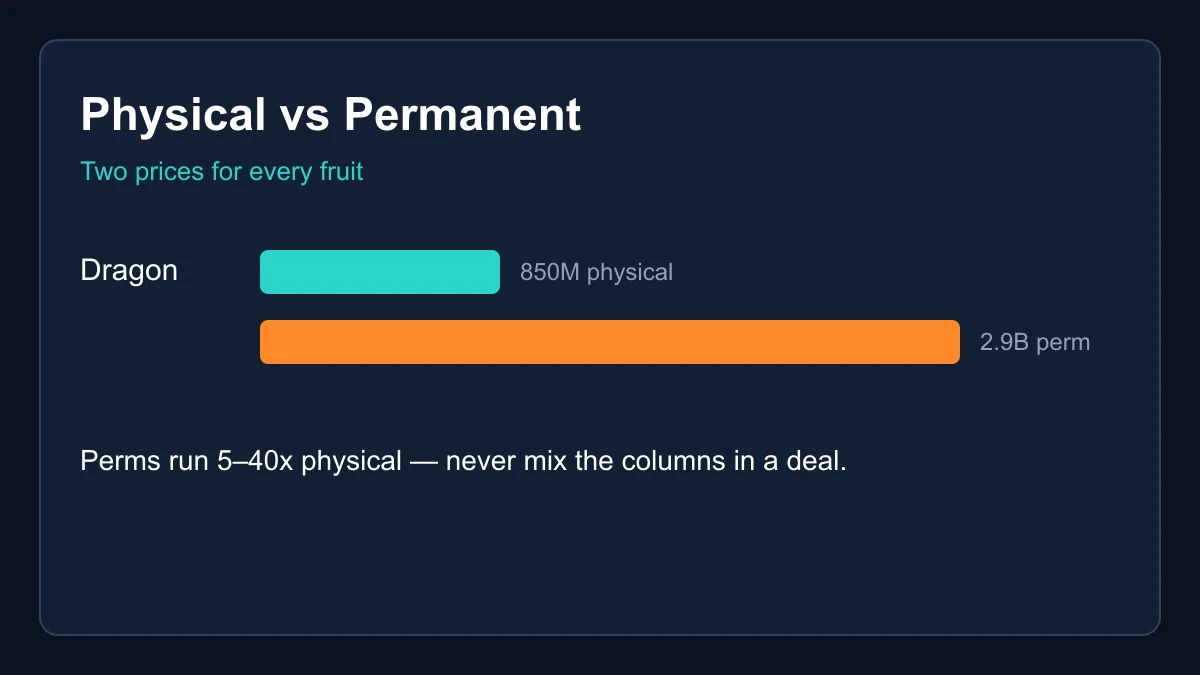
Physical vs permanent: the two prices of every fruit
Each row shows two numbers because every fruit exists in two forms. A physical fruit is the item sitting in your inventory: you can eat it, drop it, store it or trade it away, and once eaten it is gone forever. A permanent fruit is bound to your account through a Robux purchase or a perm trade: you can summon it on any server, eat it, swap builds and it never disappears. That permanence is why the perm column dwarfs the physical column — for top fruits the multiple runs from five to forty times the physical price.
The gap between the two forms is itself a signal worth reading. Fruits with a huge perm premium, like Dragon or Kitsune, are the ones players commit to long-term as their main combat fruit. Fruits with a narrow gap are the ones people hold briefly and flip. When you are offered a perm in trade, remember that perm-for-perm deals follow their own etiquette: most traders expect perm value to be matched with perm value, and mixing physical fruits into a perm deal usually requires stacking well beyond the sticker numbers.
Reading demand and trend before you trade
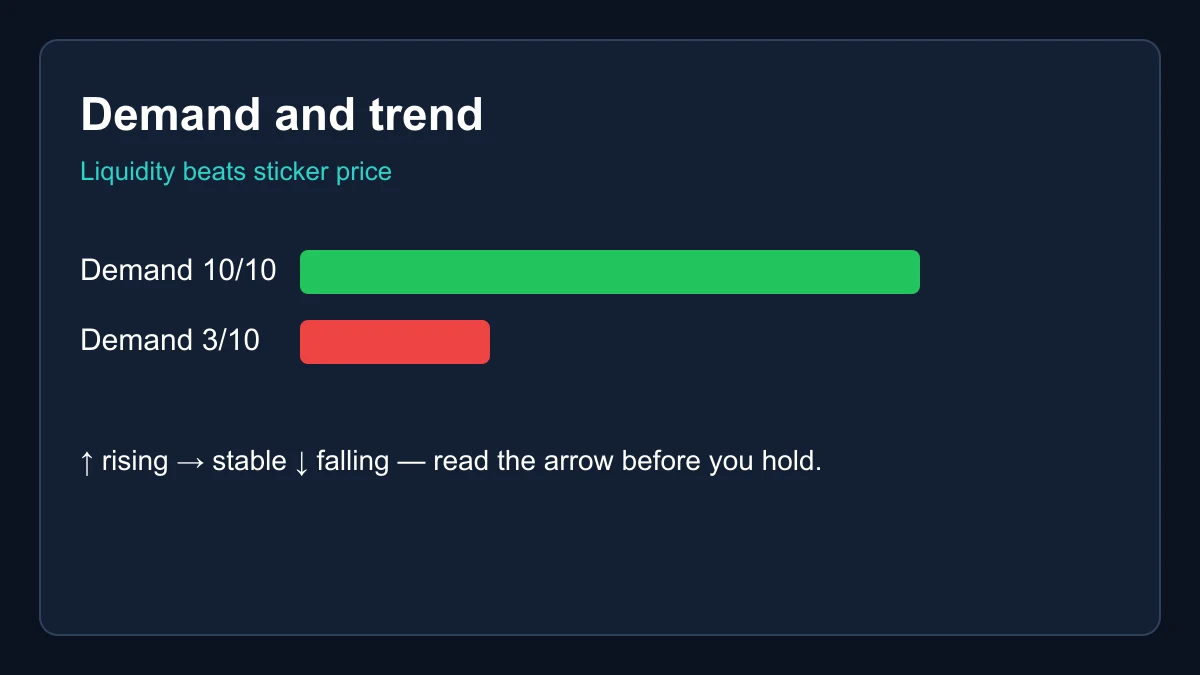
Raw worth is only half the picture; the demand column is the other half. A fruit rated nine or ten moves within minutes of being listed — Buddha is the classic example, priced modestly but wanted by every raid grinder in the game, so it trades effortlessly and often above sticker. A fruit rated three or four can sit in your inventory for days even when the number next to it looks impressive. High demand is liquidity, and liquidity is what actually converts a number on this page into fruits in your hand.
The trend arrow condenses the last few calibration passes into one glyph. An up arrow means the market rate has been climbing — usually a meta shift, a fresh buff, or supply drying up after the fruit left the dealer rotation for a while. A down arrow means the opposite: a nerf, a flood of supply, or hype cooling off. Stable means the rate held. Savvy traders buy rising fruits early and offload falling ones before the next pass locks in the drop. Pair the arrow with demand and you can spot genuinely good deals: a rising, high-demand fruit offered at last week's rate is close to free money.
Overpay: why the best fruits cost more than the sticker
Some rows carry an overpay badge, and it changes the math completely. For the handful of fruits at the very top of the food chain — Dragon and Kitsune above all — sticker price is a floor, not a fair offer. Their owners know that everyone wants one and that supply is tiny, so they routinely demand a package worth well above the listed figure before they will part with it. Offering exact sticker for a Dragon is the fastest way to get declined and, in many trading hubs, quietly labeled a lowballer.
As a rule of thumb, badge-carrying fruits expect ten to thirty percent above the listed rate, more when the fruit is trending upward. The badge cuts the other way too: if you own one of these fruits, you should be the one receiving the premium, and any offer at flat sticker is effectively asking you to take a loss. When two overpay fruits meet in the same deal the premiums roughly cancel, which is why perm-for-perm swaps between top fruits tend to clear at even numbers while mixed offers do not.
Using the numbers without getting scammed
Most trade scams do not involve hacked accounts — they involve information gaps. The classic move is rushing you: a trader flashes a stacked-looking offer, spams accept, and counts on you not knowing that three of the four fruits in the window are low-demand fillers barely worth their slot. The defense is boring and effective: check this page, add up both sides, and never accept a deal you have not priced. Thirty seconds of arithmetic beats any amount of chat-window persuasion.
A few patterns deserve special suspicion. Anyone who insists the Blox Fruits values on every public table are outdated and offers you their own private numbers is running the oldest play in the book. Anyone offering wild overpay for something you own is either confused or setting up a switch — re-read the trade window right before you confirm, because last-second item swaps remain the most reported scam in the community. And treat cross-trades that involve anything outside the game, from Robux to gift cards, as automatic scams: they are unenforceable and against the rules besides.
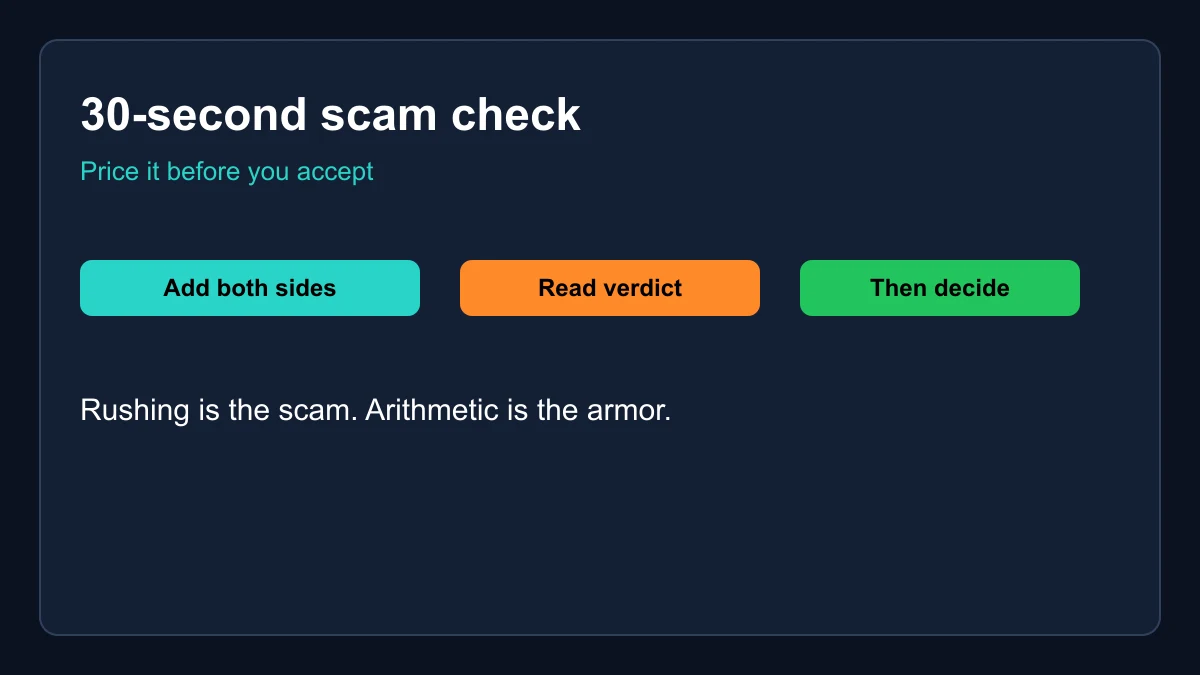
From the list to the deal
This table is the reference; the calculator is the verdict. When an offer lands, open the trade calculator, load both sides, and it applies these same numbers instantly — win, loss or fair, with totals attached. It saves you from mental arithmetic in the heat of a negotiation, and it makes overpay visible at a glance.
If you are deciding what to chase next rather than what to accept, the tier list ranks the roster for the current meta, and the stock timer tells you when the dealer refreshes so you can buy your target with Beli instead of trading up to it. The three tools plus this Blox Fruits value list cover the full loop: know the rate, verify the deal, time the purchase.
Frequently asked questions
How often is the Blox Fruits value list updated?
Weekly, with every calibration cross-checked against several large trading communities before publication. The badge at the top of the page shows the date of the latest pass.
Why is the permanent value so much higher than physical?
A permanent fruit is reusable forever on any server, while a physical fruit is consumed on use. That utility gap prices perms at five to forty times the physical rate depending on the fruit.
What does the overpay badge mean?
It marks fruits whose owners routinely demand more than sticker — typically ten to thirty percent above the listed figure. Expect to pay the premium when buying and to receive it when selling.
Are these Blox Fruits values the same on every server?
Broadly yes. The market is global because trading communities span servers, though individual deals always wobble around the consensus by a few percent.