
Updated 2026-09-28 · Update 29.5
Blox Fruits Tier List — Best Fruits Ranked
Every fruit ranked S through D for the current meta. Click any fruit for its full value breakdown, check what it trades for on the value list, and time your purchase with the stock timer.
























How this Blox Fruits tier list is ranked
A single letter has to compress three different questions: how hard does the fruit hit in PvP, how efficiently does it grind levels and raids, and how well does it hold trading worth? Our placements weight all three, because a fruit that tops one axis and fails the others is a situational pick, not an S-tier. Dragon earns its crown by dominating everywhere at once — devastating in fights, serviceable in grinding, and the single most demanded asset in the trading economy.
Placements move when the game moves. A balance patch that reworks a fruit's moveset, a new sea that changes what grinding looks like, or a demand swing in the market can all push a fruit up or down a band at the next calibration. The date badge above reflects the last review. If you disagree with a placement, the per-fruit pages show the underlying numbers — value, demand, trend — so you can see exactly which axis is carrying or dragging the rank in this Blox Fruits tier list.
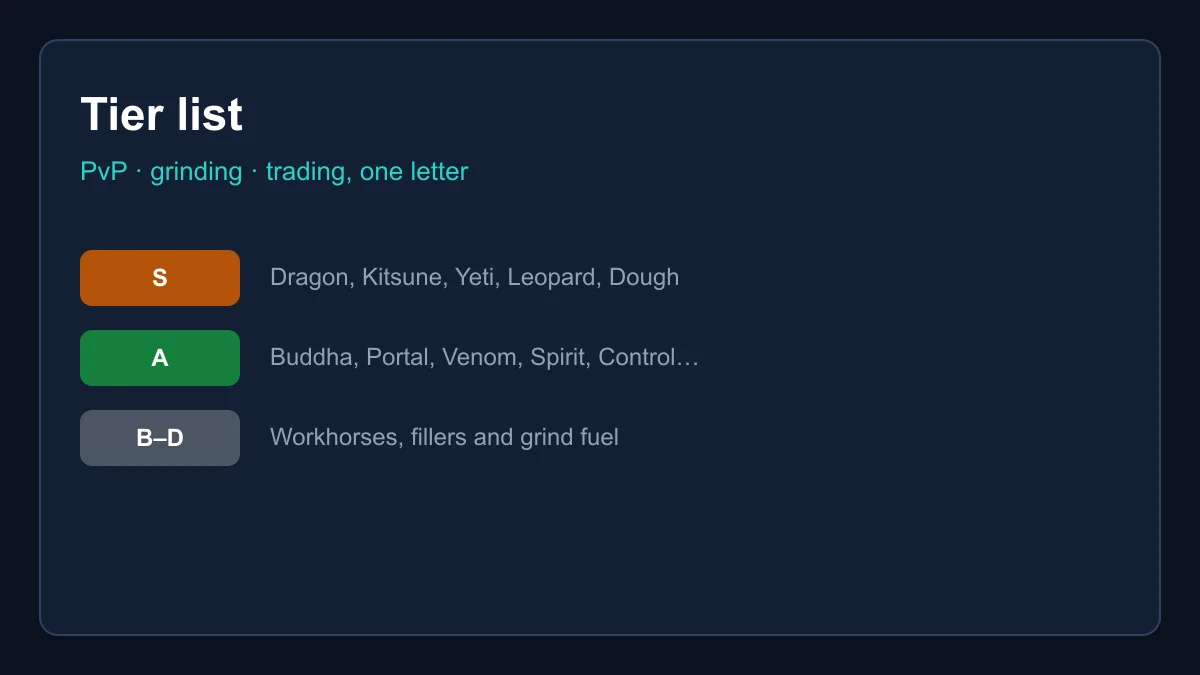
S tier: the fruits that define the meta
The top band is small on purpose. Dragon and Kitsune sit there because they win fights outright and hold overpay-level demand in trading; Yeti and Leopard follow on raw combat dominance; Dough remains the awakened all-rounder that shreds both bosses and players. Owning any of these is a position, not just a power level — they appreciate, they trade instantly, and they anchor perm-for-perm deals at the top of the economy.
The honest caveat: S tier is expensive to enter. Shop appearances are rare, stock windows close fast, and trading up to one from mid-tier holdings takes patience and several well-priced deals. If you are grinding toward the top, the efficient path is usually Buddha first — its raid utility prints Beli and trade bait — then a run of calculated flips through the A band. Watch the stock timer for lucky windows; a Mythical bought at shop price is years of flipping compressed into one purchase.
A and B tier: the workhorses
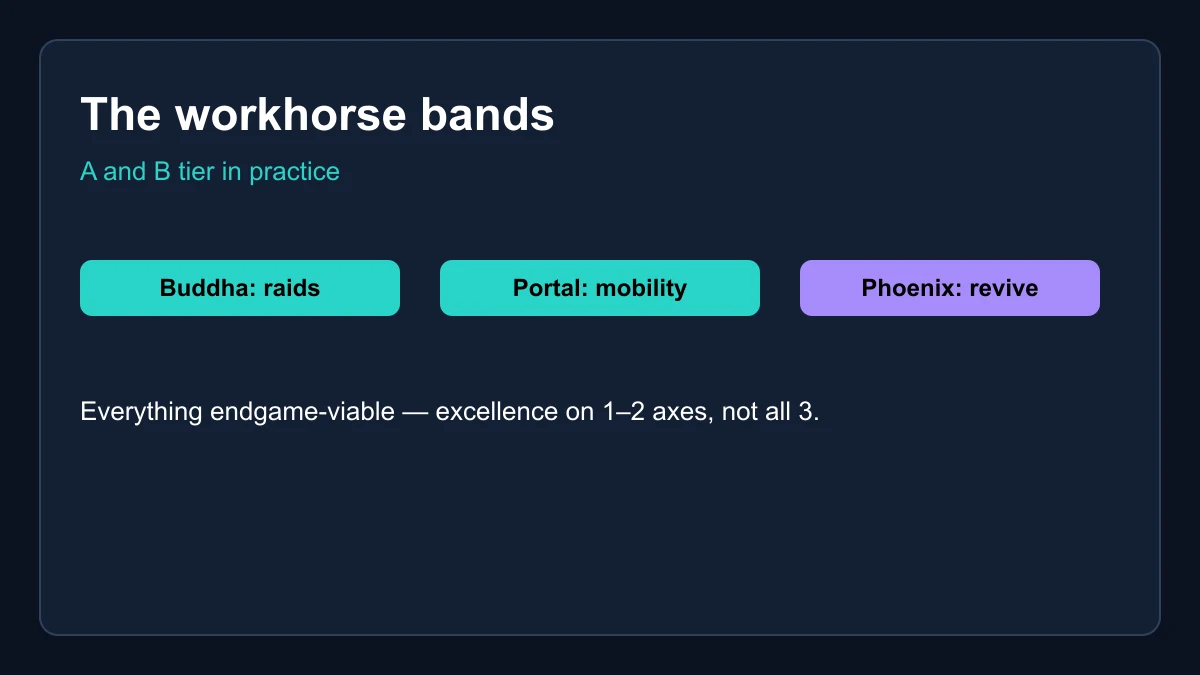
The A band is where most serious players actually live. Buddha is the raid meta incarnate and the easiest high-demand fruit to trade. Portal is prized for mobility and utility runs. Gas has climbed on the back of recent buffs, Venom and Spirit remain endgame-viable damage platforms, and Control and Shadow reward players who learn their kits. Everything here is endgame-legitimate; the difference from S tier is that these fruits excel on one or two axes instead of all three.
B tier is situational strength: Phoenix for its revive utility in team fights, Gravity and Pain for burst damage that falls off against top-tier mobility, Mammoth and T-Rex as beast-class bruisers whose demand has cooled, Blizzard and Lightning as grinding staples. Nothing in B is bad — but nothing in B is a destination either. Treat the band as a trading middle class: hold the risers, flip the fallers, and read the trend arrows on the value list before committing.
C and D tier: grind fuel and stepping stones
The lower bands exist to be used, not kept. Light remains one of the best early-grinding fruits in the game despite its bargain price, Quake clears mobs comfortably, and Sound or Spider will carry a mid-sea quest chain just fine. Their trading demand is thin, which caps their rank — but rank is not utility, and a new player who eats a C-tier fruit and grinds efficiently is playing correctly.
The strategic use of the lower bands is as trade filler. Deals often need topping up, and low-tier fruits are the small change of the economy: individually unremarkable, collectively enough to swing a close verdict to fair. Keep a couple in inventory for exactly that purpose, and check the calculator before assuming your filler is worthless. In a market where everything has a number, even D tier has a job in the Blox Fruits tier list economy.
PvP, grinding, trading: the three axes in practice
The Blox Fruits tier list axes deserve a concrete illustration, because the same fruit can grade wildly differently across them. Take Buddha: in PvP duels against top-band mobility it is merely decent, which would cap it at B on combat alone. But its grinding profile — extended melee range, tanky transformation, effortless boss clears — is arguably the best in the game, and that utility keeps trading demand pinned at nine out of ten. Two strong axes out of three: solid A, and a case study in why single-axis rankings mislead.
Now invert the exercise with a pure damage fruit like Pain. Its burst combos delete unaware opponents, which reads like a high band — but grinding with it is slow, demand is mid, and top PvP players sidestep its committal patterns. One strong axis, two weak: B tier, trending toward C when the meta speeds up. When you evaluate a fruit yourself, run this three-question audit before trusting any single letter — including ours. The letter is the summary; the axes are the argument.
Best fruit for your goal, not someone else's
The most common tier-list mistake is chasing the global best instead of the best for your situation. Leveling a fresh account? Light and the XP codes will outpace a borrowed Mythical you cannot control yet. Building raid income? Buddha over everything until your Beli engine runs. Pushing PvP leaderboards? That is where the S band earns its premium. Flipping for profit? Demand and trend matter more than the letter — an A-tier riser out-earns a stagnant S.
Use the list as a map, not a shopping order. Click into the fruits that fit your goal, compare their physical and perm worth, and let the stock timer and trade calculator turn the plan into moves. Rankings are the opinion layer; the values underneath are the market's vote, refreshed weekly. When the two disagree, trust the market and enjoy the discount.
Frequently asked questions
What is the best fruit in Blox Fruits right now?
Dragon holds the top of the tier list: dominant in PvP, serviceable everywhere else, and the most demanded trading asset in the game. Kitsune sits beside it as the other definitive S-tier hold.
How often does the Blox Fruits tier list update?
At every weekly value calibration, and immediately after major balance patches. The date badge at the top shows the last review.
Is Buddha still good?
Yes — it anchors A tier. Its raid utility keeps demand permanently high, making it both a grinding engine and one of the easiest fruits to trade at fair worth.
Should I eat a low-tier fruit or trade it?
Early game, eat whatever helps you grind — Light is excellent fuel. Once you are trading seriously, low-tier fruits work better as deal filler that tops a close trade up to fair.
Does the tier list account for awakened versions?
Yes. Where a fruit has an awakened form, the placement reflects the awakened kit — that is the version endgame players actually field. Dough is the clearest example: its awakening is what carries it into S tier, and the per-fruit page notes the awakening cost alongside its values.